Mastering OKRs for Product Success
Objectives and Key Results (OKRs) are a powerful framework for aligning teams and driving measurable progress toward strategic goals. However, OKRs are only effective when they’re rooted in a clear , coherent strategy .
By Ian Espiga, at Parser
Introduction
Objectives and Key Results (OKRs) are a powerful framework for aligning teams and driving measurable progress toward strategic goals. However, OKRs are only effective when they’re rooted in a clear, coherent strategy. Many product teams fall into the trap of setting arbitrary growth targets or fragmented initiatives, which often leads to wasted effort and missed opportunities.
This article provides a comprehensive guide to unlocking product success with OKRs, drawing from expert insights, a proven transformation framework, and real-world team experiences.
What Strategy Is (and Isn’t)
Strategy is not a collection of vague targets, a laundry list of initiatives, or a set of KPIs. It is a deliberate, coherent set of choices about where to play (markets, customers, or problems to prioritise) and how to win (how to deliver unique value and sustain a competitive edge). OKRs measure progress against these choices; they are not a substitute for strategy.
A common mistake in product organisations is starting with a leadership directive like “We need 30% growth” and scrambling to break it into quarterly OKRs. This often results in fragmented efforts that fail to compound over time, as teams pursue disconnected goals without a unifying strategy. This isn’t strategy — it’s wishful thinking disguised as methodology.
Instead, effective OKRs flow from a well-defined strategy that answers four critical questions:
- What unique value can we deliver? Identify the specific customer pain points or needs your product addresses better than alternatives.
- Where do we have a competitive advantage? Pinpoint areas where your team or product has unique strengths, such as proprietary technology or deep customer insights.
- What capabilities do we need to build? Determine the skills, processes, or technologies required to sustain your advantage.
- How will we develop and measure these capabilities? Define a plan to build and track these capabilities systematically.
For example, a weak “strategy” might be: Increase NPS by 30 points through better UX. This lacks specificity and fails to articulate a competitive edge. A stronger strategy is: Win by solving integration challenges through an API-first architecture. This provides a clear focus for OKRs, ensuring they align with a strategic vision.
OKRs vs Alternative Frameworks
To understand why OKRs were chosen for our team, we compared them with three alternative goal-setting frameworks: KPIs, Balanced Scorecard, and MBO. Each framework has strengths and limitations, but OKRs proved most effective for our product-driven context.
FrameworkDescriptionStrengthsLimitationsWhy Not Chosen for ParserOKRsA goal-setting framework with ambitious Objectives and measurable Key Results.Aligns teams on strategic priorities, encourages stretch goals, and fosters transparency.Requires a clear strategy to avoid misalignment and can be complex to implement initially.Chosen for its flexibility, transparency, and focus on measurable outcomes aligned with strategy.KPIsMetrics to track performance against specific business goals.Simple to implement, widely understood, and effective for ongoing monitoring.Lacks inspirational or strategic context; can lead to siloed focus on metrics.KPIs were too narrow and lacked the motivational aspect needed to drive cross-team alignment.Balanced ScorecardA strategic planning tool balancing financial, customer, process, and learning goals.Comprehensive view of organisational performance; aligns with long-term strategy.Complex to set up; may dilute focus with too many perspectives.Too rigid and broad for our agile product team needing rapid iteration.MBOA process where managers and employees agree on specific objectives.Promotes individual accountability and clear expectations.Can be bureaucratic; lacks team-level alignment and measurable outcomes.MBO’s focus on individual goals didn’t support our need for collaborative, team-driven outcomes.The table compares OKRs to other goal-setting frameworks to highlight why OKRs are most effective in a product-led environment.
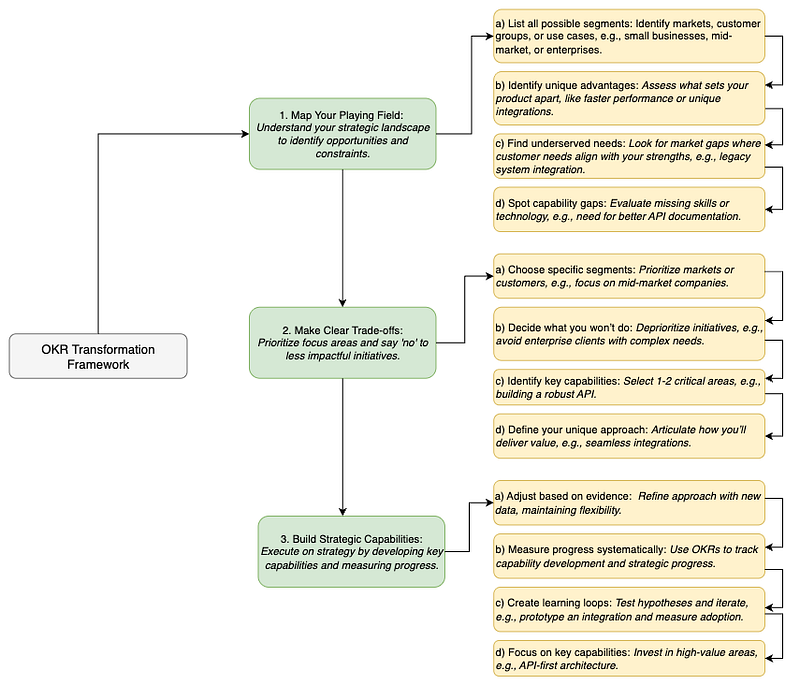
The Three-Step OKR Transformation Framework
To create impactful OKRs, product teams should follow a three-step-framework before defining objectives. This ensures OKRs are grounded in strategy and focused on building sustainable capabilities.
Why OKRs for Parser?
Parser leverages the OKR framework to drive success for our clients and partners by fostering alignment, accountability, and agility. OKRs combine ambitious, qualitative objectives with measurable, quantitative key results, inspiring teams to aim high while maintaining clear progress tracking. Unlike KPIs, which focus solely on metrics, OKRs provide strategic context to align teams toward shared goals. Compared to the Balanced Scorecard, OKRs offer greater agility, seamlessly integrating with Parser’s iterative product development cycles. Unlike MBO, OKRs prioritise team collaboration and transparency, which are essential for our cross-functional engineering, design, and product management teams. Our proven experience demonstrates that OKRs enhance alignment across diverse teams, delivering measurable outcomes that drive success across the businesses we serve.
Real-World Parser Experience
Parser applied a three-step OKR transformation framework to guide a client in aligning their organisation around strategic goals, fostering collaboration, and driving measurable outcomes. Below, we outline how we supported the client through each step, integrating key practices to ensure success.
1. Map Your Playing Field: Parser helped the client understand their strategic landscape to create OKRs grounded in organisational priorities.
- Identified key segments and opportunities: Collaborated with leadership to map customer segments (e.g., enterprise clients) and internal teams (e.g., engineering, design, product management), ensuring OKRs aligned with the client’s market goals.
- Highlighted unique advantages: Identified the client’s strengths, such as innovative product features, to inform ambitious yet achievable objectives.
- Uncovered underserved needs: Worked with cross-functional teams to pinpoint gaps, such as the need for better inter-team collaboration, which shaped OKRs focused on integration.
- Assessed capability gaps: Evaluated team skills and processes, identifying needs like improved progress tracking, which informed OKR development.
- Inclusive OKR Definition: Involved engineers, designers, and product managers in workshops to define quarterly OKRs, ensuring diverse perspectives and fostering ownership across the organisation.
2. Make Clear Trade-offs: Parser guided the client to prioritise high-impact initiatives, ensuring resources were focused effectively.
- Prioritised specific segments: Focused OKRs on key departments (e.g., product development tribes), aligning with leadership’s strategic priorities rather than spreading efforts across all areas.
- Defined what to deprioritise: Explicitly identified lower-priority initiatives, such as secondary features, to avoid diluting focus and resources.
- Selected key capabilities: Emphasised 1–2 critical areas, like streamlining cross-team dependencies, to drive OKR success.
- Articulated a unique approach: Crafted OKRs that leveraged the client’s collaborative culture, ensuring objectives promoted transparency and team alignment.
- Task Integration: Broke OKRs into actionable tasks and user stories, aligning them with department objectives to ensure clarity and focus.
3. Build Strategic Capabilities: Parser supported the client in executing OKRs by building capabilities and tracking progress systematically.
- Focused on key capabilities: Invested in processes like structured OKR tracking and cross-team collaboration tools to maximise impact.
- Created learning loops: Encouraged iterative feedback through monthly progress updates shared across teams, enabling adjustments based on real-time insights.
- Measured progress systematically: Implemented a detailed tracking table to monitor OKR metrics, progress, and confidence levels, allowing early issue detection and priority adjustments.
- Adjusted based on evidence: Used data from tracking to refine OKRs quarterly, maintaining flexibility while staying aligned with strategic goals.
- Cross-Team Transparency: Facilitated monthly updates to promote collaboration, identify dependencies, and prevent siloed efforts, ensuring OKRs drove organisation-wide outcomes.
By applying this framework, Parser enabled the client to transform OKRs into a collaborative, transparent tool that aligned teams with leadership’s strategy. The inclusive definition process fostered ownership, task integration ensured actionability, transparent updates promoted accountability, and structured tracking drove measurable results. This approach turned OKRs into a powerful mechanism for achieving meaningful, organisation-wide outcomes.
OKR Tracking Table
Below is an example of how an engineering team tracks OKRs for a quarter.
This table illustrates a practical way to monitor progress, assess risks, and maintain alignment with strategic goals.


Overcoming Common Objections
Product leaders often face resistance when implementing strategic OKRs. Here’s how to address common concerns:
- “Executives want growth targets!” → While growth is critical, it’s achieved more reliably through a clear strategy and focused OKRs than through arbitrary targets. Reframe the conversation by proposing a short strategy-mapping session: “Can we spend two hours mapping our strategic position to make OKRs more effective?” This shifts the focus from compliance to results.
- “We need to move fast!” → Speed without direction wastes effort. One product manager we mentored felt pressure to “move fast” with OKRs, but instead spent a single day mapping capabilities, identified a key integration gap, realigned the team, and met goals faster than with rushed, unfocused OKRs. Clarity accelerates progress by eliminating misaligned work.
Immediate Actions for Product Teams
To start unlocking product success with OKRs, take these steps:
- Today:
- Map your team’s current capabilities (e.g., technical strengths, customer insights).
- List explicit trade-offs (e.g., markets or features you’ll deprioritise).
- Identify strategic gaps (e.g., missing skills or technologies).
2. This Week:
- Share your analysis with the team to build consensus.
- Align on one key capability to develop (e.g., improving API performance).
- Design a measurement system, such as the OKR tracking table above.
3. Next Sprint:
- Begin building the chosen capability through targeted tasks or user stories.
- Track progress with OKRs, reviewing weekly to stay on course.
Conclusion
OKRs are not a replacement for strategy but a tool to execute it. By grounding OKRs in a clear strategy — defining where to play, making explicit trade-offs, and building key capabilities — product teams can achieve sustainable growth. Our team’s experience shows that inclusive OKR definition, alignment between tasks and objectives, and structured tracking enable teams to move fast while staying aligned with long-term goals.
References
- Wodtke, C. (2016). Radical Focus: Achieving Your Most Important Goals with Objectives and Key Results. Cucina Media.
- Niven, P. R., & Lamorte, B. (2016). Objectives and Key Results: Driving Focus, Alignment, and Engagement with OKRs. Wiley.
- Google re: Work. (n.d.). Set goals with OKRs. Available at: https://rework.withgoogle.com/en/guides/set-goals-with-okrs#bring-OKRs-to-your-organization.
- Atlassian. (n.d.). OKRs: The Ultimate Guide. Available at: https://www.atlassian.com/agile/agile-at-scale/okr.
- Mooncamp. (n.d.). OKR Software and Resources. Available at: mooncamp.com.
- George from prodmgmt.world @nurijanian.