PM, You Are Not Alone
Product management thrives on collaboration , not isolation. Using a Lego analogy and real Parser client experiences, this article demonstrates how cross-functional teamwork and tailored frameworks lead to superior product outcomes .
By Marc Milarepa Andrews, at Parser
Product management thrives on collaboration, not isolation. Using a Lego analogy and real Parser client experiences, this article demonstrates how cross-functional teamwork and tailored frameworks lead to superior product outcomes. Actionable recommendations and a custom diagram help product managers avoid common pitfalls and deliver value to all stakeholders.
Introduction
Product management can sometimes feel like a solitary pursuit, but the best outcomes are achieved through collaboration. Using the analogy of a child building with Legos, this article illustrates why involving your entire team?design, QA, technology, business, and stakeholders?is essential for product success. We?ll also share Parser?s real-world experiences, compare popular frameworks, and provide actionable lessons for PMs.
The Lego Analogy: Building Alone vs. Building Together
Imagine that you are 5 years old and you are sitting next to a huge box of Legos. Your imagination runs wild and the possibilities are endless. You don?t plan; you simply build, entering a state of flow.
The result? The most awesome creation you?ve ever made?its purpose and usage limited only by your imagination.
But when you show it to your older brother, his disapproval quickly dampens your excitement. Your parents are busy, so you don?t even try to tell them. After a biscuit break, you return to find your dog Maka chewing on your masterpiece. Frustration and tears follow.
Mum, ever the problem-solver, puts on her Product Manager cap and takes a more strategic view:
- Who are you building this for?
- Do you have all the pieces you need?
- Should we check and plan before building?
- Can you draw your idea first?
With her guidance, you start drawing, gathering pieces, and iterating. Soon, your dad and brother join in, and together you build something even better.
Problem Statement
In today?s product management world, we are often eager to start building and improving our products, sometimes following a ?natural? and egocentric evolution. Often, we forget who we are building for, or neglect to involve the right people at the right time. This can lead to misaligned outcomes, wasted effort, and missed opportunities for improvement.
Tools and Method Alternatives
At Parser, we recognise that no single framework fits every client or project. We regularly evaluate and adapt the following approaches:
- Scrum: Enables iterative development and frequent stakeholder feedback. Ideal for projects with evolving requirements.
- Kanban: Focuses on continuous delivery and managing support tasks. Useful for ongoing product maintenance and incremental improvements.
- Lean: Maximises value and minimises waste. Best for projects where efficiency and rapid validation are critical.
Why We Choose Hybrid Approaches
For many clients, we combine elements of Scrum and Kanban. This hybrid approach allows us to tailor processes to the team?s maturity, organisational culture, and product goals, maximising delivery while minimising disruption.
Parser in Action: The real life example
While working with one of our trusted clients, we were tasked with evolving a product to deliver maximum value for both the client and its users. The team was already using a mix of Scrum and Kanban. Rather than imposing a new process, we listened to the team and organisation, then modified the framework to fit their needs. For example, we encouraged teams to reflect on priorities before daily standups, so blockers could be raised and addressed more efficiently.
This step-by-step, collaborative approach reduced organisational friction and maximised delivery. The outcome was a new, evolved application tailored to the client?s needs?achieved only through deep understanding, flexibility, and cross-functional teamwork.
Diagram: Comparison between isolated Product Management and Collaborative Product Management
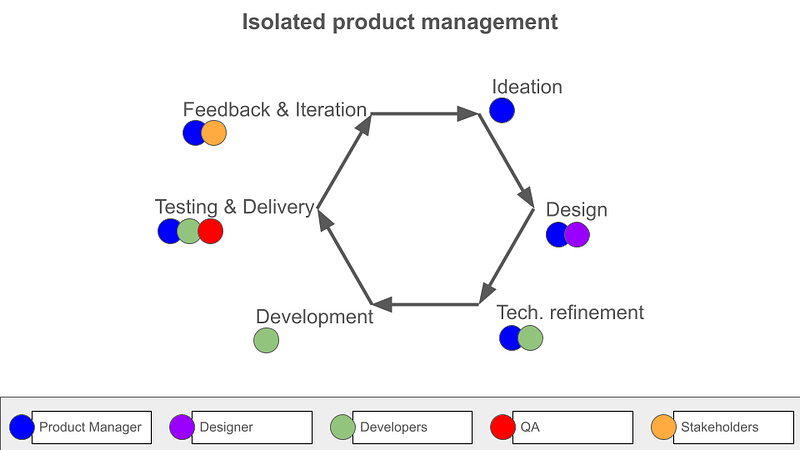
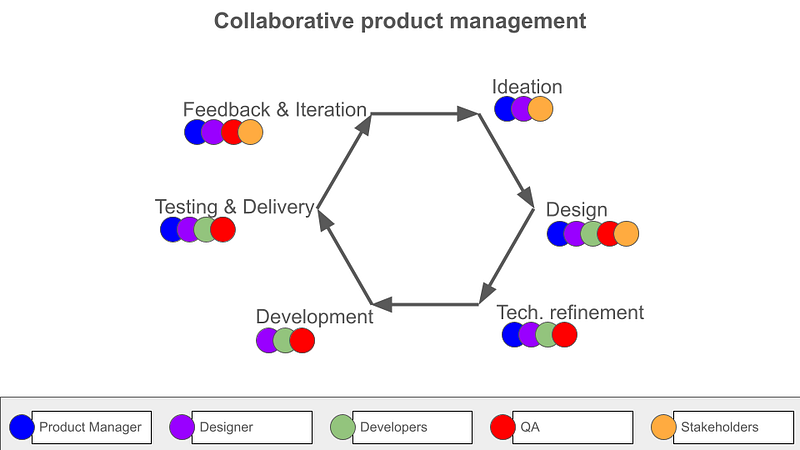
These two images illustrate the difference between traditional (isolated) and collaborative (iterative) product lifecycles. In the traditional approach, different actors?such as designers, developers, QA, and stakeholders?typically participate in only one or two steps, while the Product Manager (PM) carries responsibility throughout the entire process. Although this may seem efficient, it often leads to isolation, fragmented feedback, and a lack of context, which can slow down improvement and reduce product quality.
In contrast, a collaborative, iterative approach involves all key actors throughout the lifecycle. This ensures that feedback is coherent and context-rich, enabling the team to identify and address issues earlier. As a result, the product improves more rapidly and with fewer iterations, ultimately delivering greater value to users and stakeholders.
Lessons Learned & Recommendations
- Involve the Whole Team Early: Designers, QA, developers, and business stakeholders all bring unique perspectives that improve the final product.
- Adapt Frameworks to Fit the Team: Don?t force a one-size-fits-all process. Listen, observe, and evolve your approach based on team and client needs.
- Prioritise Communication: Regular reflection and open communication help surface blockers and align priorities.
- Iterate and Improve: Like a Lego build, your product is never truly finished. Continuous feedback and iteration are key.
Conclusion
Product management is not a solo endeavour. By embracing collaboration, adapting frameworks, and learning from each project, Parser delivers products that truly meet client and user needs. Whether you?re building with Legos or leading a cross-functional team, remember: you are not alone.
References
- Schwaber, K., & Sutherland, J. (2020). The Scrum Guide. [https://scrumguides.org/]
- Anderson, D. J. (2010). Kanban: Successful Evolutionary Change for Your Technology Business. Blue Hole Press.
- Ries, E. (2011). The Lean Startup. Crown Business.?
- IEEE Software Engineering Body of Knowledge (SWEBOK). [https://www.computer.org/education/bodies-of-knowledge/software-engineering]