Bringing AI to the Real World: Navigating Between Anti-Patterns and Technical Debt
Adopting Artificial Intelligence (AI) within organisations is rarely just a technical challenge. More often, it is a cultural and structural one.
By Fager Barh, at Parser
Adopting Artificial Intelligence (AI) within organisations is rarely just a technical challenge. More often, it is a cultural and structural one. Modern AI promises efficiency, innovation, and data-driven decision-making, yet companies operate within fragmented software landscapes, with undocumented processes and embedded anti-patterns that reflect years of improvisation. These anti-patterns manifest in monolithic legacy systems that resist integration, siloed data repositories that duplicate business logic, and organisational habits that prioritise short-term fixes over long-term design.
Technical debt in this context is not simply bad code. It is the accumulated gap between building what works today and designing what might be perfect tomorrow. Sometimes, this debt emerges from bold decisions that kept the business alive; other times, it is the result of avoiding structural change for years. AI adoption must be able to operate within that debt rather than waiting for its full repayment, because waiting for “perfection” would mean delaying all the value AI can bring.
Pragmatism as the Path Forward
The pragmatic maxim applies here: the best architecture is the one the client already has. Innovation cannot ignore the operational DNA of a company. If an AI solution demands a clean, textbook architecture before it can deliver value, it is unlikely to survive the transition from proof-of-concept to production. The focus must be on integration with what exists, embedding intelligence into the living architecture of the business rather than demanding a wholesale replacement.
This is the principle behind the AI-kernel. Inspired by the micro-kernel approach in systems architecture, the AI-kernel introduces a small, resilient core that evolves independently while speaking fluently with each Business Unit (BU) through what we call Knowledge Interfaces (KIs). These interfaces allow business units to preserve their autonomy and their “secret sauce,” while still translating messy, idiosyncratic processes into clean, contract-driven interactions with the core. In this way, anti-patterns and technical debt remain quarantined at the edges rather than contaminating the centre.
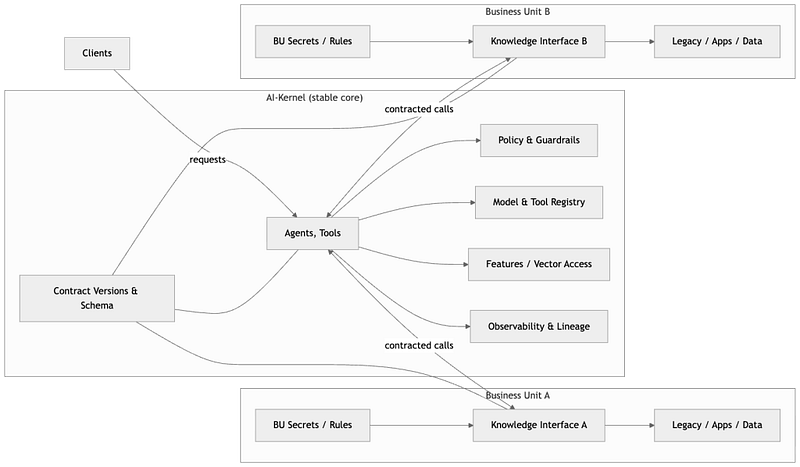
The AI-kernel flips the traditional model of AI adoption. Instead of centralising all intelligence into a monolithic layer or scattering pilots across disconnected projects, the kernel becomes a stable nucleus — observable, versioned, and scalable — while business units remain the owners of their processes and innovations. The result is an organisation that can evolve incrementally, avoiding the risk of massive downtime or failed “big bang” transformations.
A Glimpse of the Architecture
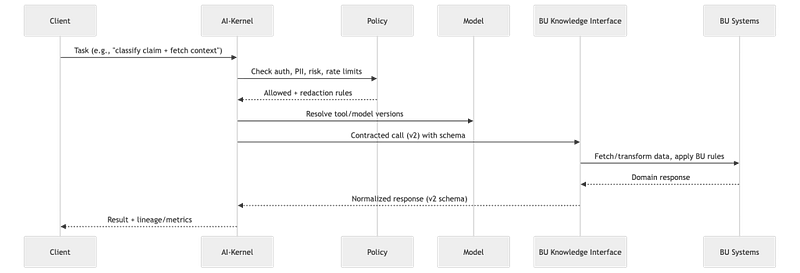
At the centre lies the kernel itself: a compact but powerful core that manages orchestration, policy, registries, observability, and contract services. Business units interact with it through their own Knowledge Interfaces, which translate local systems and processes into standardised contracts. Oddities, batch windows, CSV quirks, or partial fields never make their way into the kernel. Instead, they are absorbed and contained within each KI, ensuring the core remains clean, resilient, and future-ready.
Because both kernel and KIs are versioned independently, change becomes safe. Upgrades can roll out with zero downtime. The kernel can evolve from version two to version three while still accepting calls from version two interfaces. Business units then adopt the new version when they are ready, not under pressure. Observability is built in from day one, ensuring that lineage, model versions, evaluation metrics, and mappings are visible across the ecosystem.
A Minimal Adoption Plan
Rolling out an MVP (Minimum Viable Product) AI-kernel does not require tearing down the house and rebuilding from the ground up. The philosophy is to deliver value quickly, prove feasibility in controlled conditions, and expand organically.
Step-by-Step AI Implementation Plan:
- Identify high-value, low-disruption use cases. To accelerate this process, Parser offers Parser.AI Workbench, a pre-built environment where AI models and integration patterns can be tested directly inside the client’s systems. It connects to real data sources, simulates workflows, and benchmarks different models against well-defined KPIs such as accuracy, latency, and cost. What normally takes months of discovery can be reduced to weeks, producing a shortlist of opportunities validated in the client’s own context.
- Stand up a thin-slice AI-kernel. This early version is intentionally minimal, containing only the orchestrator, policy guardrails, a model registry, and basic observability features. The goal is not to deliver a complete product but to establish a learning core that can grow.
- Wrap selected business units with Knowledge Interfaces. Each unit develops its interface according to the kernel’s contract, mapping local systems and data into normalised formats while shielding the core from any legacy quirks. In doing so, business units maintain control of their specific processes while contributing to a unified, evolving AI capability.
- Pilot through shadow and canary deployments. In shadow mode, the AI-kernel runs in parallel without affecting production, gathering metrics and validating accuracy. In canary mode, a small percentage of real traffic flows through the kernel, allowing the organisation to test its resilience under real conditions. Importantly, feedback loops are continuous; waiting until the end of a pilot to collect feedback often leads to disengagement.
- Measure, learn, and refine. With observability in place, teams can evaluate accuracy, latency, business impact, and user feedback, then iterate rapidly. Models can be swapped, prompts refined, and interfaces adjusted, all without disrupting the rest of the organisation. Within a few months, the organisation achieves a stable AI core that delivers tangible business value while remaining insulated from legacy complexity.
From MVP to Scale
Once the MVP demonstrates success, the path to scale becomes clearer. More business units can be brought into the ecosystem through new Knowledge Interfaces. Additional capabilities, such as retrieval, summarisation, or prediction, can be added to the kernel. Contracts and versioning policies become standardised, and mature interfaces can migrate smoothly to newer versions. Most importantly, internal expertise grows around the kernel, ensuring that the organisation does not depend solely on external partners for long-term operation.
Business Value Impact
AI adoption should not be about fighting enterprise complexity. Instead, it should transform legacy systems, process idiosyncrasies, and even technical debt into managed boundaries that allow innovation at the pace of the business. The AI-kernel architecture provides exactly that: a pragmatic strategy that delivers zero-downtime upgrades, continuous evolution, and measurable business impact without the risks of large-scale replacements.
The expected outcome is not just a set of successful pilots but the emergence of a governed, enterprise-wide AI capability. It is an approach that grows in value over time, supports compliance and observability, and prepares the organisation for tomorrow’s opportunities while making the most of the architecture it already has today.
At Parser, we bring all the ingredients required to make this a reality: model evaluation workbenches that accelerate discovery, integration accelerators that reduce complexity, governance frameworks that ensure safety, and domain-specific expertise to tailor the solution.
Our experience shows that AI can be implemented swiftly, sustainably, and with measurable impact from the very first day.