An AI-Based Evaluation Strategy for Generative Text Systems
Generative AI systems, particularly those that produce text based on prompts, have become increasingly important in various applications, from chatbots to content creation. Ensuring these systems function correctly is essential for maintaining quality and trustworthiness.
Generative AI systems, particularly those that produce text based on prompts, have become increasingly important in various applications, from chatbots to content creation. Ensuring these systems function correctly is essential for maintaining quality and trustworthiness. This article discusses the importance of testing generative text AI, the types of tests to apply, a practical testing process, and a step-by-step example using a locally deployable AI model.
WhyTesting Generative AI Is Important
Testing generative AI ensures the system produces accurate, high-quality outputs while mitigating risks such as bias and security vulnerabilities. It also helps ensure compliance with legal and ethical standards, fostering trust in AI-driven systems. Key reasons for testing Generative AI include:
- Quality Assurance: Ensures that the generated content meets quality standards and is relevant to user queries.
- Error Identification: Helps identify potential biases or inaccuracies in the generated responses.
- User Trust: Builds user confidence in the system by ensuring it delivers reliable and accurate information.
- Compliance: Ensures that the content generated adheres to legal and ethical standards.
Types of Tests to Apply
When evaluating generative AI systems, particularly those generating text based on prompts, you should consider applying the following types of tests:
- Functional Testing: Verifying that the system produces the expected outputs for given inputs.
- Performance Testing: Assessing how well the system performs under various loads and conditions.
- Usability Testing: Evaluating how easily users can interact with the system and understand its outputs.
- Content Quality Testing: Checking if generated content meets predefined quality standards (e.g., coherence, relevance).
- Bias Detection Testing: Identifying potential biases in generated responses based on input prompts.
- Robustness Testing: Evaluating how well the model handles unexpected or malformed inputs.
Functional Testing Process with a Practical Example
Below is a step-by-step breakdown of how to implement an automated functional test using AI to test a Generative AI, with a previous testing process definition that should be followed for this approach in particular.
Testing Process
- Define Test Cases: Identify specific scenarios to test based on expected use cases and edge cases.
- Generate Expected Outputs: Use a reliable model to create expected outputs for comparison.
- Automate Testing: Implement a script that sends prompts to the generative AI model and compares the responses against expected outputs.
- Evaluate Results: Determine whether the responses meet predefined criteria (e.g., accuracy above 90%).
Practical Example:
In this example, we will use an open-source generative text model that can be downloaded and run locally, such as GPT-2 or a similar model. The goal is to automate a test that sends a prompt to the application under test and compares the response with a predefined generated expected output.
Step 1: Setting Up the Environment
- Download and Install Model: Download GPT-2 from Hugging Face’s Transformers library or similar sources.
- Install Required Libraries: Ensure you have Python installed along with libraries like ‘transformers’ and ‘torch’.
Step 2: Define Test Cases
Create a list of test cases for your generative model:
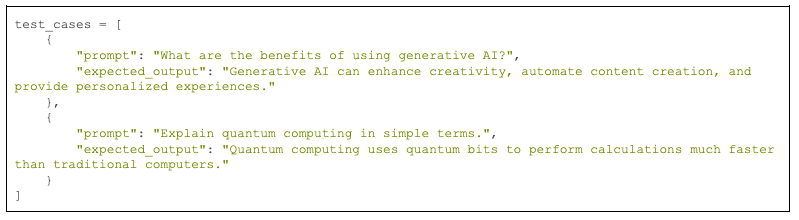
Step 3: Generate Responses from the Model
Use the following code snippet to generate responses from your local AI model:
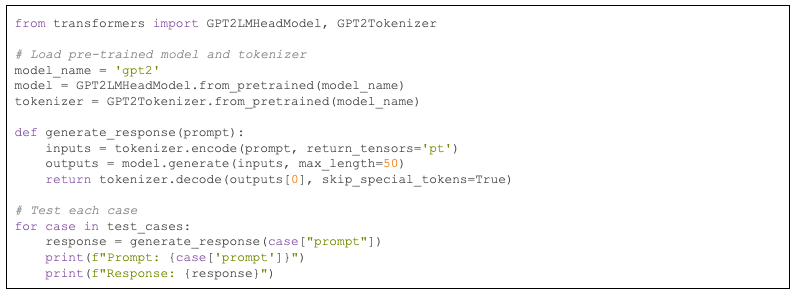
Step 4: Compare Responses with Expected Outputs
Now compare the generated responses with your expected outputs, ensuring that the similarity between the generated response and the expected output is at least 90%:
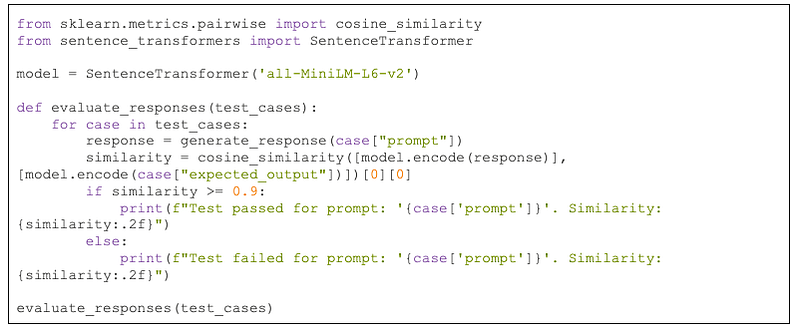
We use the sentence-transformers library in this code to compute the cosine similarity between the generated response and the expected output. If the similarity is greater than or equal to 0.9 (90%), the test is considered passed. This ensures that the generated response is highly similar to the expected output.
Analysis of Results
The implementation of this approach allows teams to:
- Automate Validation of Non-Deterministic Responses: This testing strategy is particularly effective for automatically validating non-deterministic responses from AI systems. By leveraging AI’s capabilities, teams can ensure that the outputs generated are consistent and reliable, even when faced with varying input prompts.
- Enhance Output Consistency: Automated testing helps maintain a high level of consistency in the outputs produced by generative AI systems. This is crucial for applications where reliability is key, as it minimises discrepancies that could arise from manual testing processes.
- Streamline Testing Processes: By automating the validation of responses, teams can significantly reduce the time and effort required for manual testing. This allows for a more efficient workflow, enabling testers to focus on more complex scenarios that require human insight.
- Improve Detection of Edge Cases: The automated approach facilitates the identification of edge cases that may not be covered by traditional testing methods. This ensures a more comprehensive evaluation of the generative AI’s capabilities and enhances overall system robustness.
- Adapt to Changing Requirements: As generative AI systems evolve and new functionalities are introduced, this testing approach can quickly adapt by validating new scenarios and outputs based on updated specifications. This flexibility is essential for maintaining high-quality standards throughout the development lifecycle.
Conclusions
The implementation of automated testing for generative AI systems using AI enhances both efficiency and effectiveness in validating these complex systems. By leveraging advanced techniques such as machine learning for similarity assessment, teams can ensure that their generative models produce high-quality outputs consistently. This approach not only streamlines testing processes but also fosters greater confidence in generative AI applications by ensuring they meet user expectations and perform reliably across diverse scenarios.